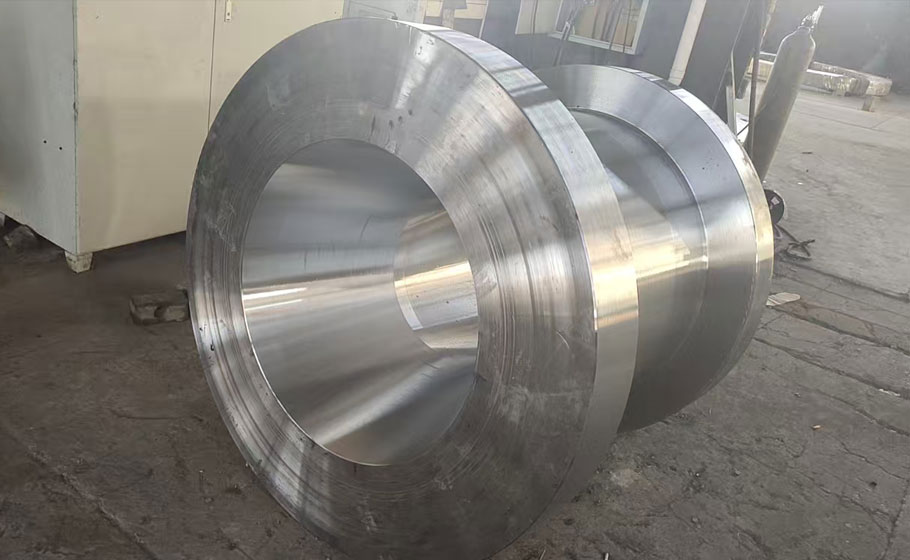
Cold forging of flanges is at low temperature forging, the size of the flange changes very little. Forging below 700℃, less oxide skin formation, and no decarbonization on the surface. Therefore, as long as the deformation energy is within the forming energy range, cold forging is easy to obtain good dimensional accuracy and surface finish. As long as the temperature and lubrication cooling are well controlled, the temperature forging below 700℃ can also obtain good accuracy. Cold die forging, cold extrusion, cold heading and other plastic processing collectively. Cold forging is the molding process of the material below the recrystallization temperature, and the forging is carried out below the recovery temperature. In production, it is customary to forge without heating the blank called cold forging. Cold forging materials are mostly aluminum and some alloys, copper and some alloys, low carbon steel, medium carbon steel and low alloy structural steel with small deformation resistance at room temperature. Cold forgings have good surface quality, high dimensional accuracy and can replace some cutting processes. Cold forging can strengthen the metal and improve the strength of the flange.
Hot forged flange and cold forged flange
The development of cold forging technology is mainly to develop high value-added products, reduce production costs, at the same time, it is also constantly to the cutting, powder metallurgy, casting, hot forging, sheet metal forming process and other fields of penetration or replacement, can also be combined with these processes to form a composite process.
The hot forging of the flange is: when hot forging, because the deformation energy and deformation resistance are very small, large flanges with complex shapes can be forged. To obtain a flange with high dimensional accuracy, it can be machined with hot forging in the temperature range of 900-1000℃. In addition, attention should be paid to improving the working environment of hot forging. Forging die life (hot forging 2-5 thousand, warm forging 1-20,000, cold forging 20-50,000) is shorter than forging in other temperature domains, but it has large degrees of freedom and low cost. The purpose of hot forging flange is mainly to reduce the deformation resistance of metal, thus reducing the forging pressure required for bad material deformation, so that the tonnage of forging equipment is greatly reduced; By changing the cast structure of the flanged ingot, recrystallization during the hot forging process can change the coarse cast structure into the new grain structure, reduce the defects of the cast structure and improve the mechanical properties of the steel.